
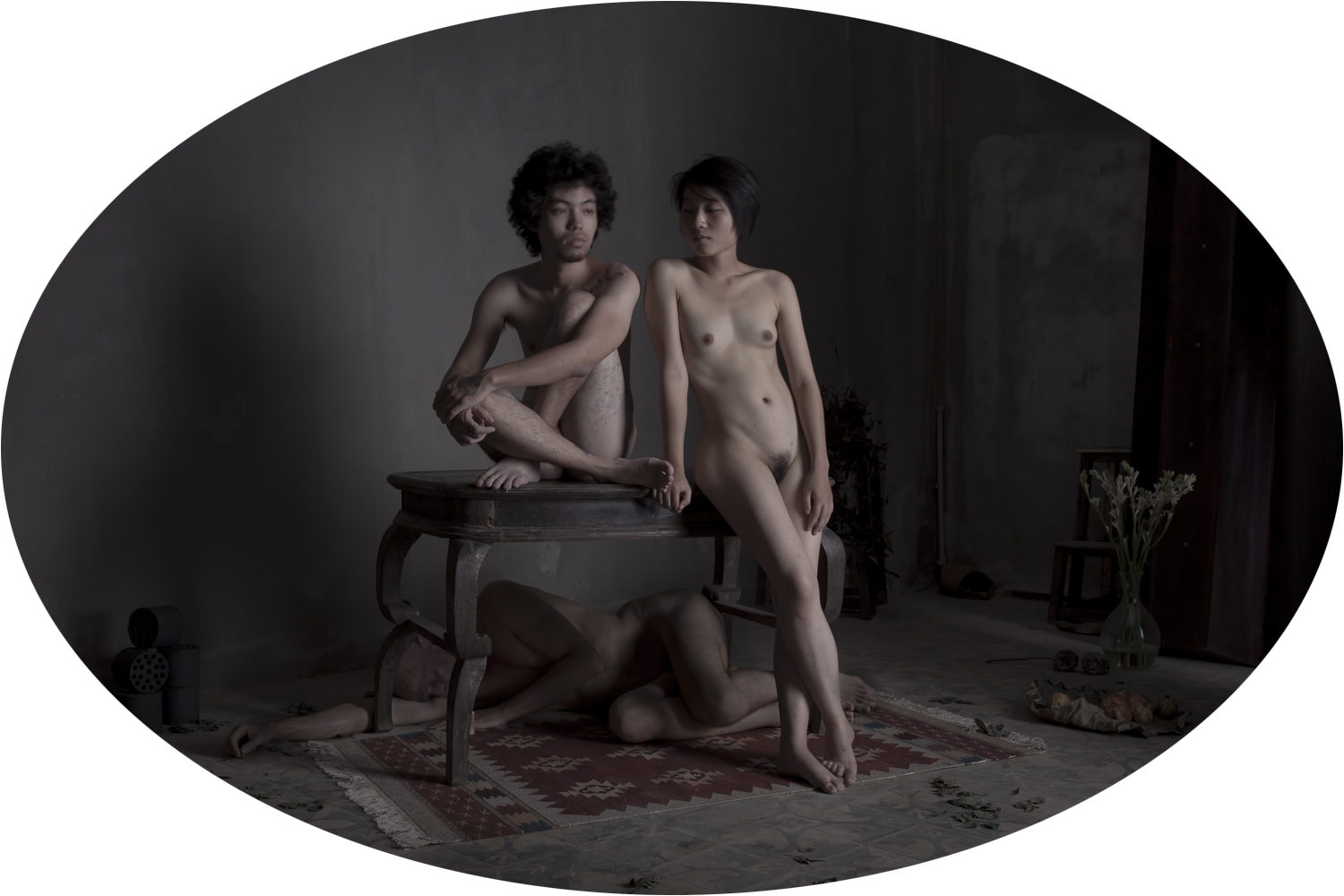
Nguyễn Hoàng Nam: That day, I came in the room with my girlfriend to be a part of your series. We didn’t hesitate to take off our clothes after a few first shots. Everything happened naturally, it seemed like your existence, your camera and the two of us tenderly merged with the space around us then vanished. I felt peaceful and I know we all shared that feeling. It’s the peaceful feeling of being silent and painting beauty with silence. You will never see anything twice in your life, everything will change the next time we sit together, even if we sat in the same room and the same angle of light came through the north windows, I know.
Let’s imagine you hang two photos side by side, one with people and one without, what do you think you will see?
I like considering your series as an example of existentialism. Let’s imagine you hang two photos side by side, one with people and one without, what do you think you will see? I’ve heard that sometimes you can only feel the existence of something by feeling its absence.
Jamie Maxtone-Graham: I think you raise a very interesting point here; that of existentialism. One can argue that images are perhaps proof of existence. We were together in that room on that day in that way as individuals – each of us with our own distinct impression of the event and time. But as you point out, there was a shared (social) experience and it is perhaps at that point that existentialism ends. Each of us individually gave meaning to the moment and the experience but after that I think we have to conclude the existential moment is over. An image without people can definitely bear elements of existence – the physical presence of people is not, I believe, a requirement for proof of this.
An image without people can definitely bear elements of existence – the physical presence of people is not, I believe, a requirement for proof of this.
We were, once. We continue, though differently. We will be gone, definitely. The existential debate is too complicated and too full of disagreement to be definitively argued by me. But one thing I found important quite early in this series was the space around the people, the emptiness of it, the void around the people, the absence. I worked in this small room for nearly six months and I never felt like I ran out of possibility for what to see or how to see it. If I could imagine it, I could realize it – make it exist. Sartre speaks of ‘encountering oneself’ and I would say this was a fundamental element of the work seen here – encountering myself in the literal process of encountering others. Kierkegaard said, ‘the subjective thinker has only one setting -existence… The setting is inwardness in existing as a human being.’ So existentialism is neither an external expression nor a physical proof, as argued by these two. Maybe the room itself was a metaphor for this inward existence.


