
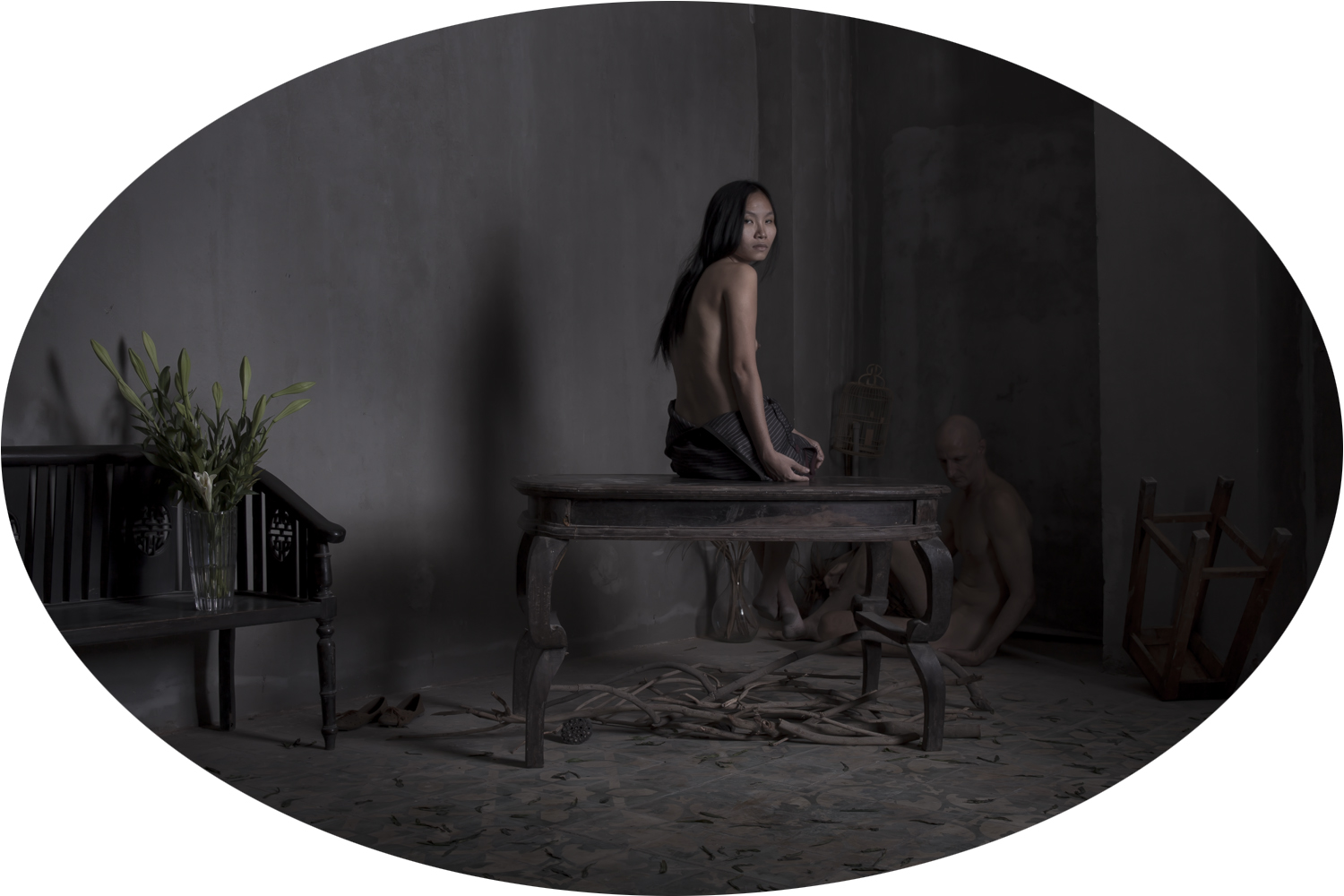
Nha Thuyen:
coming into a darkening space
even the naked eyes couldn’t reveal my own ineffable dizziness
all i could be at the moment of being closer or more distant
just the faded shadow of an endless memory of what- haven’t -ever -happened
i am holding the broken words in my hand, watching them leaving each other
till
the unnameable sadness and love nurtured in the familiar strangeness of my body have disappeared in the void
where
no one would be excluded
i was there and i am not here
the faint moon was shot
what were you looking for?
what can save you for a moment? what can you save and what can save you? or what things make you saved?
what can I save and what can save me at the moment? what things make me saved? i think of my self of the now, i think of some beautiful moments of love, friendship and magical connections that can save some fragments of my life. i save all of those fragile moments to be saved – here and there and somewhere and nowhere in time and space, no time no space.
Jamie Maxtone-Graham: In making this work, I was looking for something I hadn’t seen before – either in work by others or by myself. As I get deeper into producing my own work – which is to say photography that I conceive of and produce out of my own interest in making it – I think it is paramount to be loyal to an instinct, an impulse, an interior voice which only one person can hear and follow. I have worked commercially in film and photography and made work for others and I have never, ever really been able to make the kind of work I want to make for a client; one or the other of us is always disappointed. More than any other previous series I have made, I was looking for something that was really quite interior. The fact that this is the first series I have produced in an indoor space is a condition not lost on me. In numerous previous series, I used artificial (interior) lighting outside in a public space. For this work, I took the natural (exterior) daylight and used it as the sole source of illumination in an interior space.
Increasingly, I want to make work that, while personal, also tries to connect to, to converse with something I have learned or felt about art or the history of art. So when you ask ‘what was I looking for’, maybe I can tell you I am looking for my place in that history. Maybe it is arrogant to think that I might even have a place. But in this obscure corner of SE Asia, in this tough little city we live in with the people around me who challenge me and inspire me, who depress me, with my own life and being as a man, a father, a husband – I know I can try to go deeper into myself and attempt, at least, a dialog.
To address something towards the second part of this question – about saving, salvation: you know, a large part of this series for me is about mortality. I am in my mid-fifties and in that weirdly conscious place where I am closer, certainly, to my death than to my birth. So perhaps one reason I chose to portray myself in shadow is some reflection of that relationship I have both to my own existence and to the existence of others. Even the title – That Little Distance – is a reference both to the space between us all and to the time we have remaining. It is actually part of a quote from something I heard John Cage say – he spoke of ‘that little distance before the end’. It really struck me, the way he put that – it is so simple. And he was not a young man when he said it.
Nothing can be saved. That is the truth of it. The images I make save nothing; I am not saved by them nor is anyone else.
Nothing can be saved. That is the truth of it. The images I make save nothing; I am not saved by them nor is anyone else. In truth, one person I felt very close to who posed with me in this series died just 7 months after we made the photograph. I didn’t know at the time, and perhaps he only suspected, that he was sick and going to die – maybe he didn’t. The making or the not making of the photograph would change nothing. He is gone and someday I will be too, as we all will be. So what is the point? Why? Einstein said, “The question ‘Why’ in the human sphere is easy to answer: to create satisfaction for ourselves and for other people. In the extra-human sphere the question has no meaning.” But my friend and I, as with many others I made images with – including yourself, Nha Thuyen – became somewhat slightly closer or came to some greater understanding of one another through the making of these images together. I think we did. I am satisfied we did. And that is a kind of magic that I always hope for in making work beyond the actual magic of a really satisfying photograph.


