
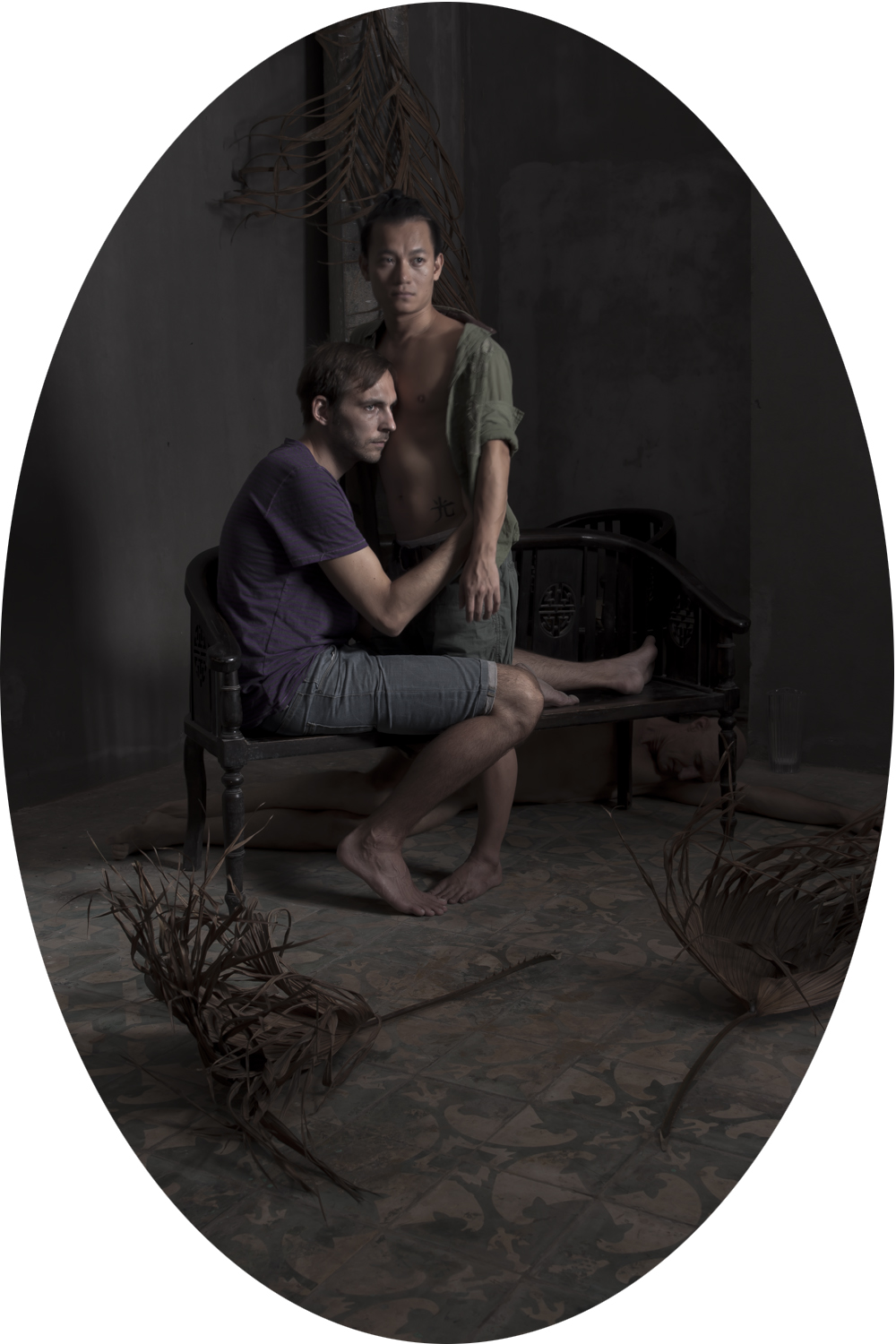
Thomas Blecha: Funnily, the image looks kind of cold to me, though the process of shooting it in the studio was rather hot – it was in the end of summer in Hanoi. Before the shoot I was a bit worried, I guess, about being in the room together with my boy and a naked photographer – that either he or I would feel uncomfortable, though usually nudity does not bother me much. But during the shoot I was busy to find a right position, looking steady somewhere away and concentrating on breathing lightly, so I forgot about the nudity. And looking at the picture, it is not about the nakedness of the photographer who stays in the back, in the dark. It is about the portrait subjects.
Which distance do you mean referring to the title?
Which distance do you mean referring to the title? Some friend told me he finds especially our picture kind of “anti racist” – because what he sees is a white tall guy sitting and leaning on the standing, tall Asian boy. What do you think about that? How would you describe the look of your sitters – do they look serious or sad or strong to you?
Jamie Maxtone-Graham: In this image, I am hardly noticeable since the way I lay behind the bench, the light barely touched my body.
The distance in the title touches upon any number of ideas … it certainly may refer to physical distance, emotional distance or the distance as measured by time – between people in the image or those viewing it. Whichever measure feels the most important for each person…
The distance in the title touches upon any number of ideas which I like the viewer to think about more than I care to explicitly explain. But it certainly may refer to physical distance, emotional distance or the distance as measured by time – between people in the image or those viewing it. Whichever measure feels the most important for each person, it’s that little distance I’m interested in. I mentioned previously that the title came to me after hearing the artist John Cage speak about distance as he referenced the time he had left to live.
I find the image of you and Tuan really strong in the way you are somewhat physically subservient to him – you hold him, you lean against his bare chest, you seem to be lovers in the photo but he also seems to barely notice you. There is an implied authority in that attitude even if it might be a fiction since we/I created this pose for the purpose of the image – but it was based on something. So yes, in that you – the white male – seem to be in a position of diminished authority to this Asian male, there could be found an alternative power relation in that. What do I think about that? – that it’s really great your friend felt that and brought it to your attention. I also think it reflects some truth as well. You and I – we are visitors in this place. Even if the locale is not explicit in the images, you and I are both outsiders and subservient to the dominant cultural idea of place and I’m glad that seems present in this image.
This is also really the first time I have made work that included people who weren’t Vietnamese (there have been other attempted series but this is the first complete one), so this is quite a relevant point regarding my own practice and perhaps reflects an attitude of my own ideas of race and power. It’s a complicated issue, particularly as it relates to photography and media, and deserves broad, open and honest discussion.
What I try for, relative to people’s expressions and your question about ‘serious, sad or strong’, is the total relaxation of the face. I don’t want people ‘indicating’ anything – not an emotion, not a feeling – just to be there as simply as possible. That is what I want to see – a complete lack of projected expression. When the viewer can fill in that space, that distance, with what they bring to the experience of looking at an image – it’s in this moment that something interesting.


