
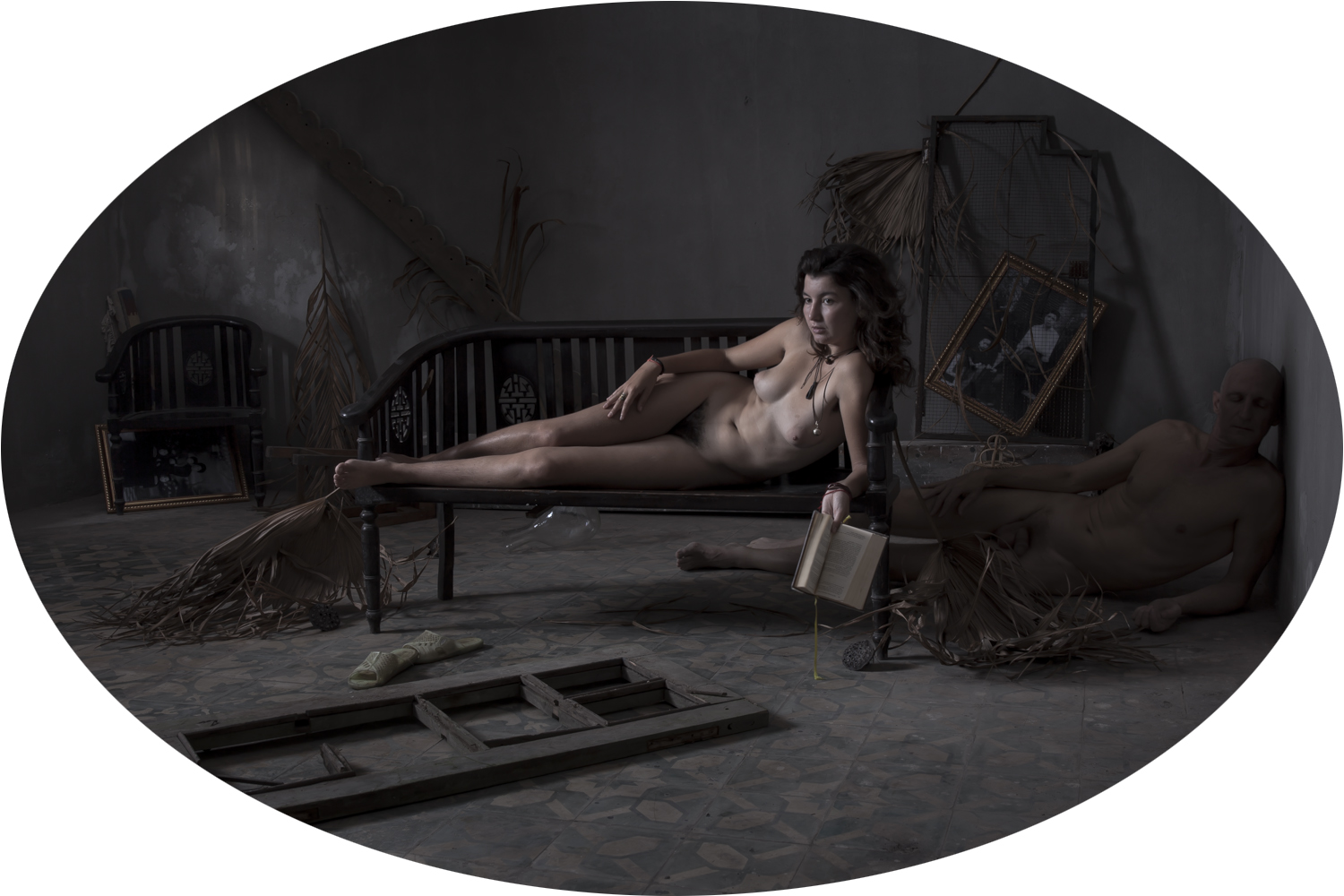
Amelia Nanni: Well….the first thing I remember is that it was more difficult than I could expect to stay still without moving for 20 seconds. And the other thing, and this is maybe because I shoot pictures too, is that I understand how difficult it can be to give the right expression to the photographer. I was surprised to discover that it was difficult for me to control my own expression; for example I was thinking to give one particular expression but after seeing the photograph, I discovered someone else. One other thing; I really love this meeting and how we so naturally made this picture! It was an excellent memory of a human and artistic meeting. I didn’t know you but I just trusted you completely, like we’ve known one another a long time.
How did this idea come to you, what was the first interrogation?
When you are yourself in the picture, do you come as a person, as a character, or as a photographer? What do you mean your presence? How did this idea come to you, what was the first interrogation? why nude? and the different object in the picture it is just graphic or they have some symbolic meaning?
Jamie Maxtone-Graham: I came into the photographs as all three – as myself, then also as someone in the role of a person in the photograph and finally as the photographer. It was a delicate challenge to juggle these roles – the photographer was looking for specific elements and making sure the technical and aesthetic issues were being addressed. But he also had to be sure the character of both himself and you, the sitter, were working to support the idea. And then the objective self, me, who is there in the room with you – it was important to be able to participate in that way too, to feel the atmosphere and the mood that you helped create by being there with me. You understood the idea very quickly and were so agreeable – I knew right away we would make a good photograph. And it didn’t take long before we had made several very interesting ones. And then it was complete.
The first interrogation was with time – historic time and literal time; through this series I wanted to have a conversation with a period of time and the art of that time.
The first interrogation was with time – historic time and literal time; through this series I wanted to have a conversation with a period of time and the art of that time. Neoclassical art came into prominence in Europe right as photography was being developed. Early photographers fell into the spirit of the neoclassical movement (which is itself a conversation with an earlier period of Greek history and art) and – to oversimplify it – embraced the aesthetic of painters. So I felt both grounded in that, connected but also a kind of freedom to say something about the time and the place where I am, where we are, today. I feel certain that people looking at this work will feel something about that, either through the light or the muted color palette or through the mood. But it is also confused with people who are very much of this time. Also, in the years I have been photographing here in Vietnam, this is the first series where I have felt the naturalness and appropriateness of including Western subjects.
The nudity was partly a natural extension of the neoclassical dialog. It’s also to do with the presence of nature within the confines of this enclosed room. The same is true with the objects and the furniture in the room. In the beginning, the scenes were more simply conceived, but as I made more images, I began experimenting with more complicated arrangements, exploring some possibilities. I also included fruit, flowers and other perishable, organic items. And I reused these again and again. They would appear ripe and fresh in one image and slowly, over time as I reused them, they would fade, rot and die. I don’t arrange the images chronologically according to the lifespan of these objects, but the fact that they have a life and perish on camera is part of the work and part of the intent, the meaning, of it.


