
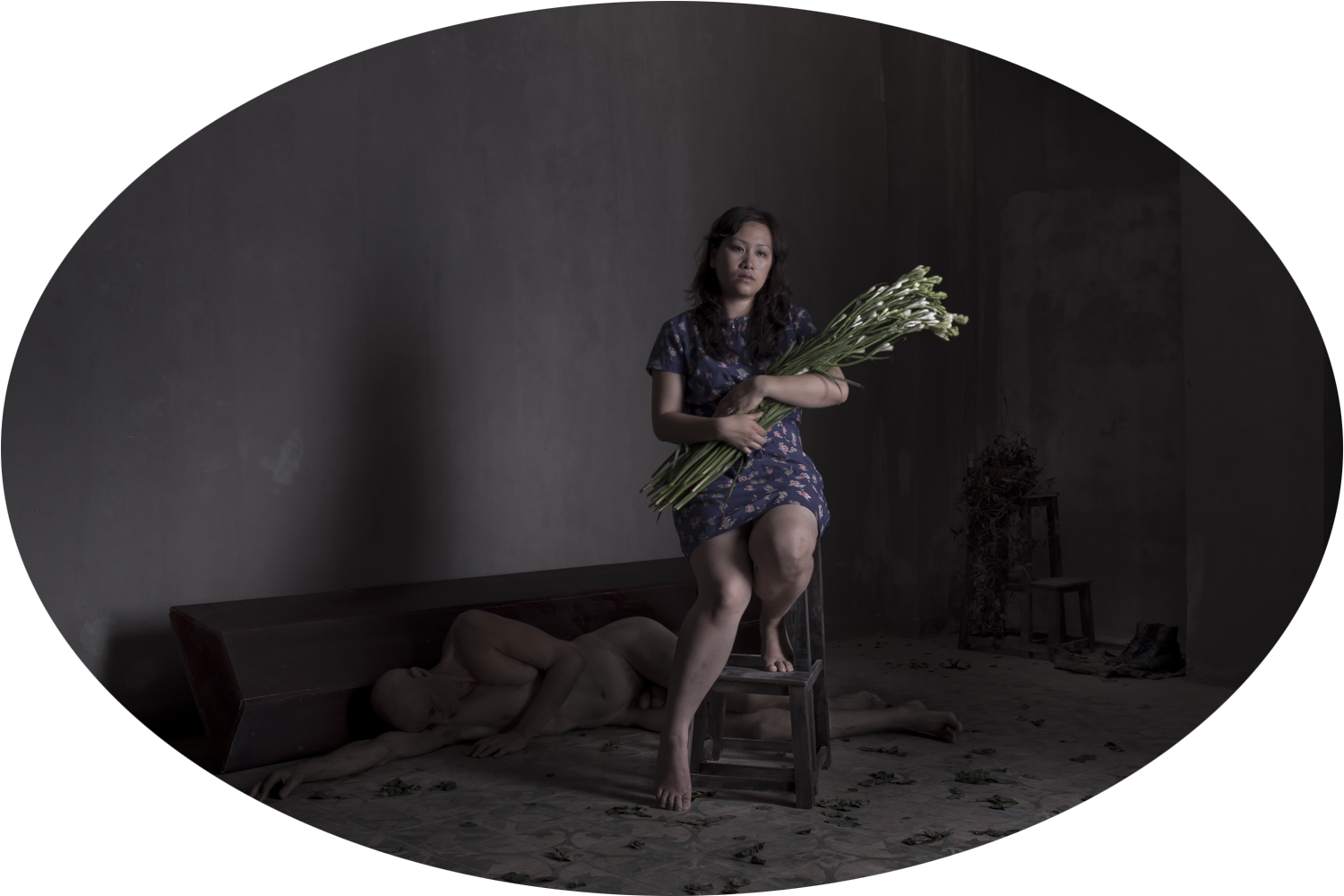
Nhung Walsh: Because this was somewhat a self-portrait, it was like entering someone else’s dream; weird but fascinating at the same time. It definitely created a surreal feel to it and I was glad that the dream situation actually happened, in daylight, literally. You kept yourself in the background most of the time, so while shooting, in the back of my head I was wondering: “what is he doing?” At the time of shooting, I associated the performative ghostly and strange (and naked) figure in the picture with a landscape instead of a person; that there was nobody there but me. I’d like to think that the haunting landscape itself is a living creature and I am with it, and maybe I am it. Because the creature was naked, I think many people will think about intimacy or some kind of provocative sexual desire. But I was not scared and did not feel intimate in a sexual sense. Instead, I felt calm, safe, and comfortable.
Were you disappointed when your subjects refused to shoot naked or half naked?
What is the most important element for you in this set – the light, the people, or your image?
You asked your subjects for permission to shoot them ideally naked or half naked. Were you disappointed when your subjects refused to shoot naked or half naked? I guess it’s more difficult in Vietnam when nude is still a taboo issue. How did you anticipate this?
Jamie Maxtone-Graham: Of course I am setting out to make something photographically exceptional and because the images are composed of people in light, they must each function in some kind of insane balance for me to find the kind of image I can be satisfied with. I can only shape the light. So the excitement for me is to see what can come from the person I am working with. Sometimes that takes time and sometimes it comes easily. When it doesn’t come at all (as happens occasionally), it is my failure and not the other person’s. That is a case of me not being persistent enough or clear enough in my direction. But in general, all things must be in some form of support of the other things – the light, the expression of the subject and the overall compositional elements. You also raise this very important point of the self-portrait.
It is not easy to reveal oneself to others in this way and difficult enough to confront oneself. Some people I have photographed nude for the first time really welcomed the opportunity to be challenged in this way, to risk nudity and being documented.
You know, in the beginning I was not interested in photographing others nude at all, partially or otherwise. I thought it would be more interesting if I were the only one nude in the image. I changed my thinking about this though. Some people volunteered to be nude. Some I even asked not to undress. Some I agreed to let do so. Some, like yourself, I asked be partially undressed and they declined. Some I asked and they agreed. This is not something I need to push for. The important thing for me is the absolute comfort and relaxed nature of the people in the image. Nothing good can come out of an unwilling sitter. I think your impression of Vietnamese people being uncomfortable with (their own) nudity is not completely correct; some of my most willing nudes were Vietnamese. I was turned down equally by non-Vietnamese as well – I think that all people generally have body issues of one sort or another; some form of shame about their own nude image – I include myself. This is not a Western or Eastern conceit. It is not easy to reveal oneself to others in this way and difficult enough to confront oneself. Some people I have photographed nude for the first time really welcomed the opportunity to be challenged in this way, to risk nudity and being documented. And I think without exception, those who did found something beautiful in themselves.


