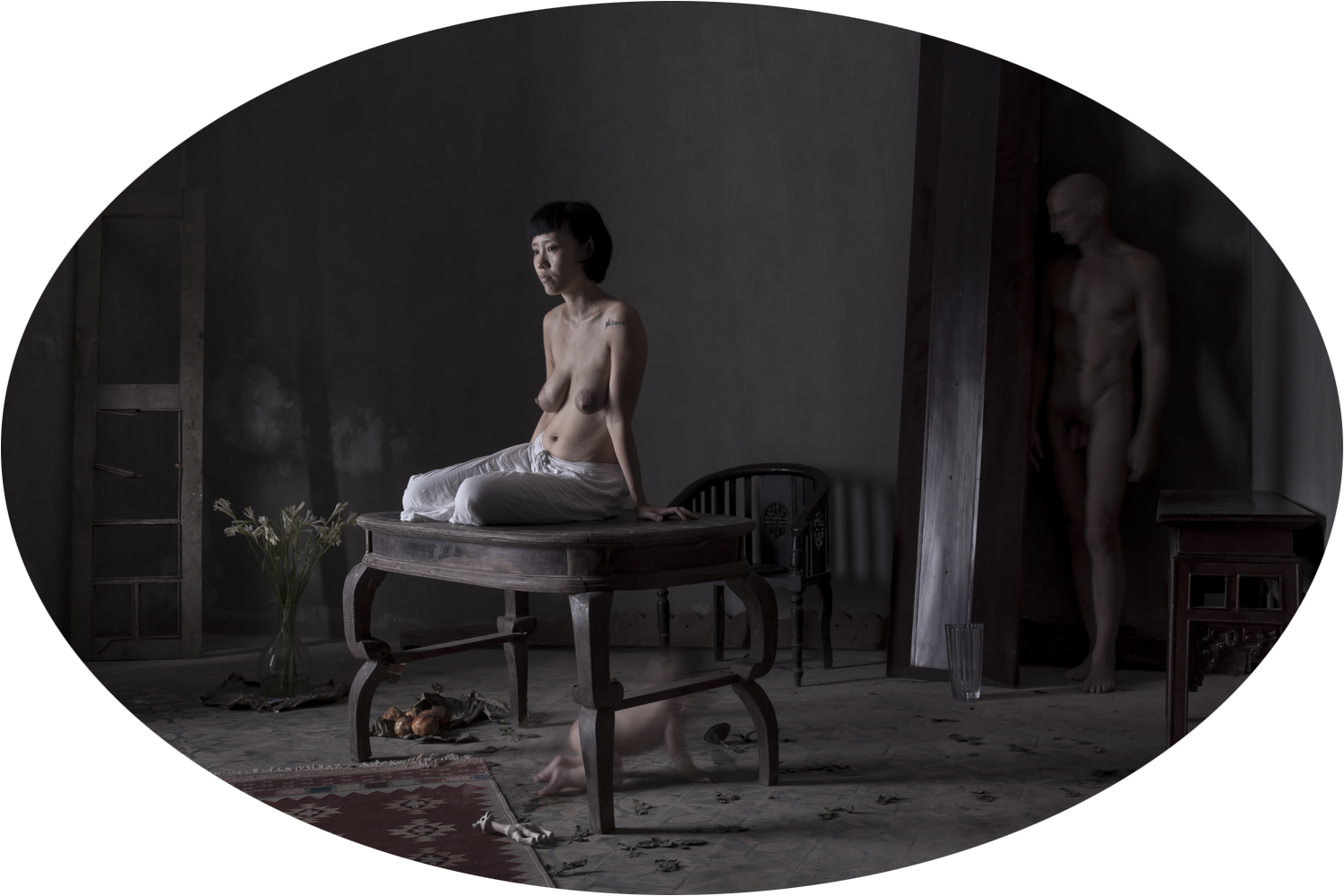
Hà Lan Anh: When Jamie invited my daughter Mila and me to participate in his project, I felt both the resistance and desire to say yes. Resistance because I was not sure how my daughter would see it later, how the project would be curated and represented.
But being in the room and doing the portrait with Jamie and Mila that day felt like being in a Tarkovsky movie, or in a magical realist book where everyone is somehow connected, but there is no linear chronicle of time, and the photo of one person is retold in someone else. Both the objects the people were very quiet, minimal in our colors, mirror and reflections, draperies of cloth, even our breath was so light that it felt like we could even hear spirits moving in between. The studio space was ghostly but it felt safe, like a theatrical space guarded for us to play this image sculpturing game. But it was a difficult game of self-control and irrational behaviors, spontaneity and constraints. In several frames, my body placed itself in order with no thought at all, while in others I found my pose but had to adjust because my daughter moved. I did not pay attention to what Jamie was doing and did not even know where he was until I saw the final photo. And where Jamie is in all the portraits is probably one of the aspects I like most about this series.
I’m curious to know if the white male identity is a privilege or a burden for you in your collaborative creative process and how do you feel with that?
I never saw him nude (before this). When I saw the portrait, I was impressed by how symmetrical he is, in contrast to the many asymmetrical models. Sometimes he mirrored people like a buffoon, sometimes he was in the background quietly like a prop, sometimes it was a perfect balance and sometimes it was not.
How does it feel for you to be the only and always naked white man in the series? And how does that sense of identity influence the spontaneity when you create the image with other people, including the Vietnamese women, disabled, gays, etc? I guess I’m curious to know if the white male identity is a privilege or a burden for you in your collaborative creative process and how do you feel with that?
Jamie Maxtone-Graham: I am quite aware of my whiteness living in this very non-white place. I am reminded daily of my otherness – and that is a very complicated existence, made more so by the use of the camera and the power of that instrument to dictate the message.
I am quite aware of my whiteness living in this very non-white place. I am reminded daily of my otherness – and that is a very complicated existence, made more so by the use of the camera and the power of that instrument to dictate the message.
It is one reason I have worked nearly exclusively in portraiture for the past several years; although I still dictate the message, I also offer collaboration or, more importantly, the right to say ‘no’. I think this is a quite important distinction in the nature of work made by someone from the developed world working in the developing world. I wont pretend it’s a perfect system, but the relationship between subject and author is a flatter, slightly more equal one.
One aspect of appearing nude in these images is also to give to the other person sharing the frame everything that is me – to literally strip bare, conceal nothing, offer everything as a gesture towards that relationship of power, a kind of vulnerability. So yes, you are a woman, as well as a woman of another race and I have even made a nude portrait of you previous to this. But to me, there was no difference in my thinking in making the previous portrait where I was dressed and you were not and making this one where I was nude and you only partially. The real interest for me was in finding the perfect pitch of the work. Even allowing Mila the freedom to be herself in the moment of the image – her blurred presence was the exact right note for the work, an improvisation I couldn’t possibly have conceived of but that I try always to be open to as well. So whether the image was with a gay couple, a disabled Vietnamese woman, another white male, a mixed race couple, a mother and infant daughter – I was determined to represent myself equally to and before all of you. I don’t pretend to have an exact or perfect response to this issue except to deal with it directly and openly. Working this way requires a sense of trust.
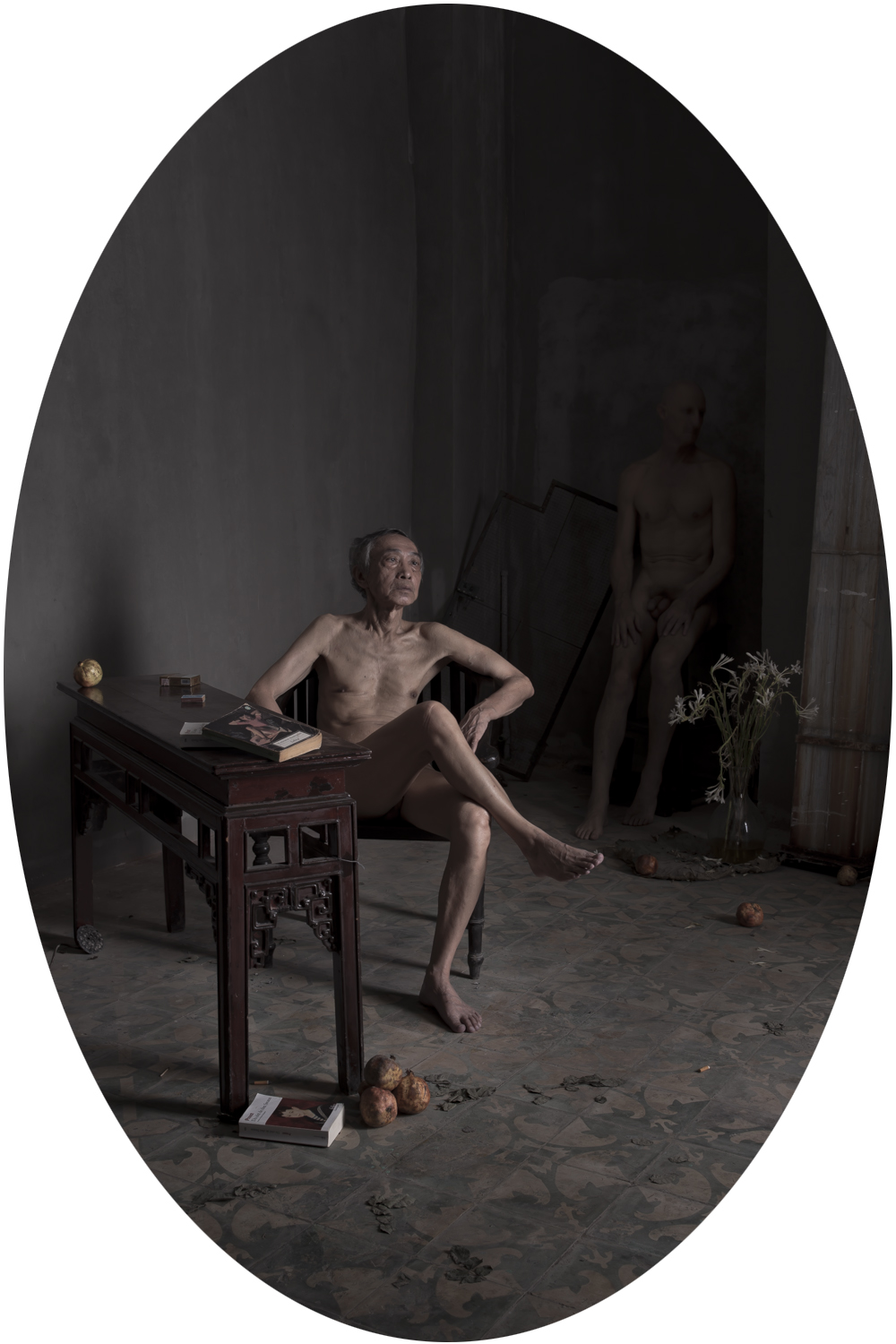
It’s interesting because when I look at these images I hardly notice difference – not between gender or sexual preference or race or ability – although, perhaps in one way, the series might be exactly about that. I looked for different kinds of people and couples and ages of people to sit with me so perhaps it is more about that than I am ready to admit. I know I was interested in a broadly inclusive palette of people. Actually, I wish I had been able to photograph more old people, particularly older women; to be honest, that is something I feel is missing. I really love the image of Trần Dương Tường who posed nude for me – he was 81 when we made that photograph. He is amazing.