
Two of Hanoi’s most talented young photographers talk about what inspires them, how you get strangers to let you in on their most personal moments and their upcoming projects.
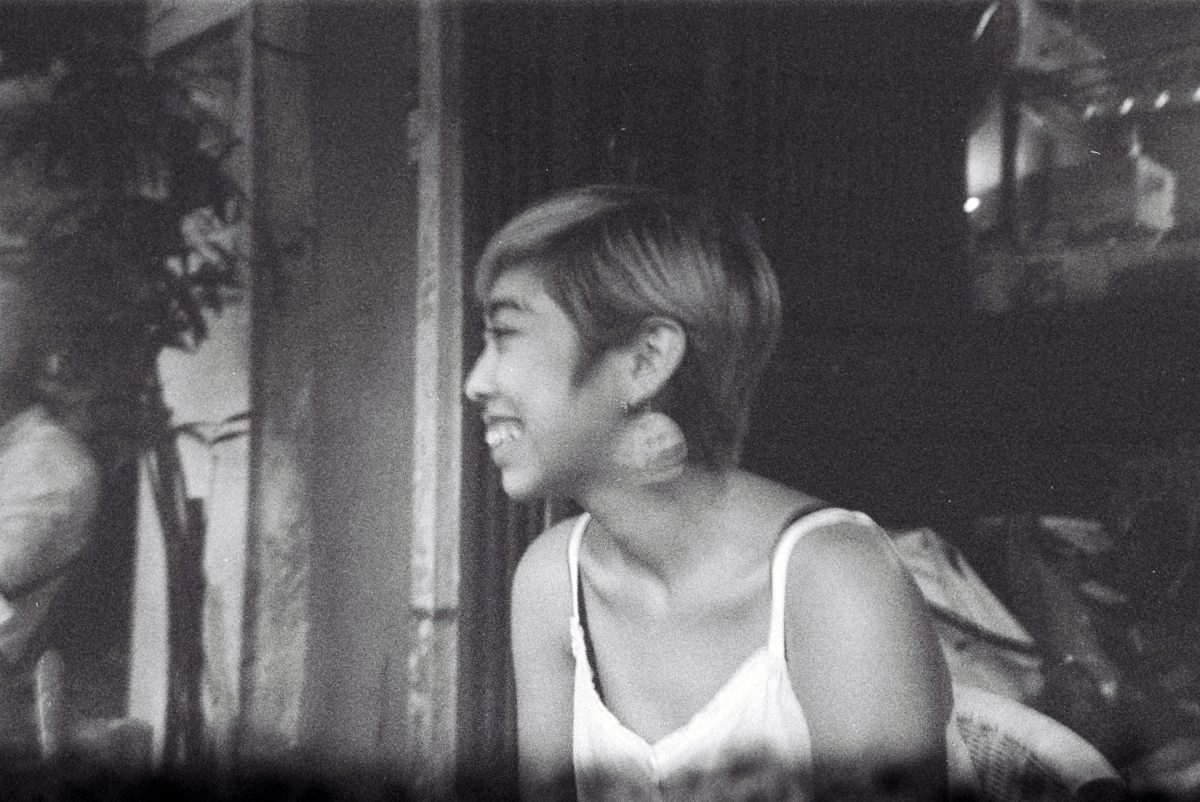
Thủy Tiên photographed by Maika Elan
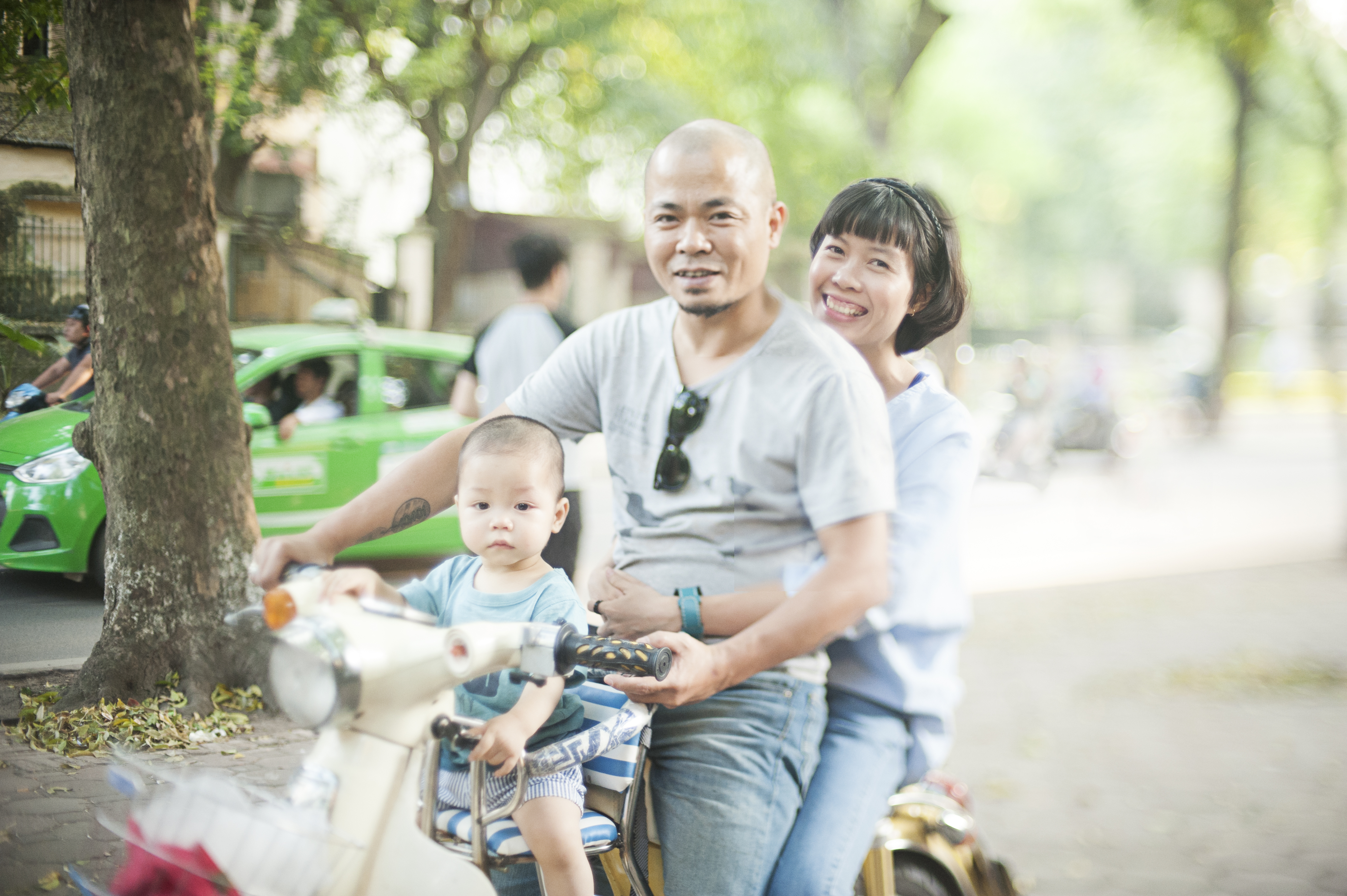
Maika Elan & her family photographed by Thủy Tiên
Maika Elan started her career in photography doing fashion and editorial shoots. Her first documentary project ‘The Pink Choice’, an intimate portrayal of gay partners at home together, won a World Press Photo prize, a Pride Photo Award and an Indochina Media Memorial Foundation Award. In her most recent project Maika turned her camera closer to home, depicting her ailing father in surreal pastiches of him as he is now mixed with images that reminded Maika of him. Maika was born in Hanoi in 1986.
Thủy Tiên, born in 1993 only graduated from university this summer but has already been tipped as an up-and-coming artist to be excited by, including by & Of Other Things’s own Bill Nguyen. She first garnered attention after participating in the ‘Autopsy of Days‘ workshop run by DocLab for which she shoot intimate portrayals of domestic life. Thủy Tiên went on to collaborate with the artists of Nhà Sàn Collective and showed her work, both as part of group shows and in a recent solo exhibition. Besides photography she also works in performance and conceptual art and has been picked for Sàn Art’s Laboratory. She will be doing the residency in Ho Chi Minh City for the remainder of this year.
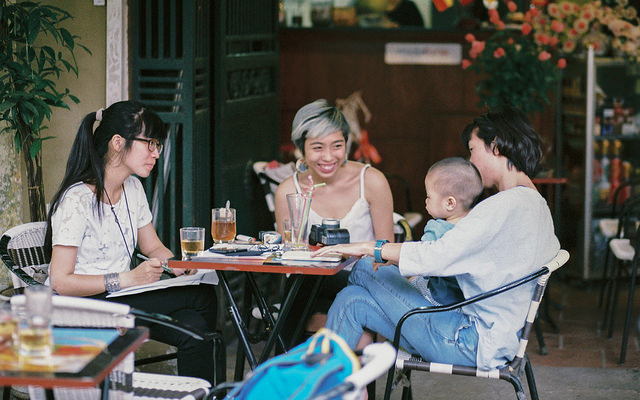
Interview and translation by Luu Thuy Nhung ● Edited by Rose Arnold ● Images by Huong
PORTRAYING THE LIVES OF OTHERS OR PERSONAL STORIES
Thủy Tiên: These two are not so different. No matter if you’re portraying life around you or your own world, there needs to be something coming directly from yourself, your own thoughts.
Maika Elan: I don’t think it’s possible to separate them. At the start [as a photographer], you usually photograph things around you first, then when you have enough life experience you start to dream of bigger things. After that, perhaps, you might start to feel like you, yourself, and things and people close to you are more important. Perhaps you’ll go back to these simple things.
Thủy Tiên: When portraying strangers, I don’t really feel a need to get more involved in their personal lives. I even find it a bit uncomfortable if they expose their lives too much. I just want to let them know that they are being photographed and what I’m going to do with those photos, because they have a right to know. Maybe documentary is not really my thing. I feel like it’s not quite fair on the one being photographed.
I’m working on a project called ID, and instead of documenting other people, I’m portraying myself.
Maika Elan: The most crucial thing [with photographing strangers] is being honest and straightforward. You need to let them know exactly what you’re doing, without any invention. For example, when I did ‘Pink Choice’, I was quite open about my purpose. It wasn’t a social project or campaign for gay people’s rights and benefits, it was just my personal project. I was curious and wanted to have a clearer insight into their lives. I didn’t know if the photos would become anything big.
ON WHAT PHOTOGRAPHY IS
Maika Elan: Photography is many things. You can do reportage, use it to portray life, to reflect the dark side. Or perhaps you want to tell a story, then it is documentary. If you want to make it an art form, then you pull in some concepts. Photography is everything and anything, depending on what you’re up to. It can also just be used foe selling things, like fashion photography.
Thủy Tiên: I don’t really consider myself a professional photographer. Photography to me is simply a tool. I use other kinds of art to express my ideas and inspiration, not just photography.
Sometimes I use photography as a reason to get to know new people, like when I really like someone but don’t know how to start, I ask him/her to take some photos, then get closer onwards. My way of thinking is a bit different as sometimes, my products are not photographs. Photography is just a mean for me to approach something.
ON INSPIRATION
Thủy Tiên: I’m usually inspired by artists like Tracey Emin, whose products are not photographs, but who have some interesting ideas and take on things. Tracey Emin does performance, installation. I particular like her piece ‘My Bed’.
Maika Elan: I like many photographers and each of them inspires me in a different way, but I’m not particularly crazy about one photographer in particular. Actually, for each period, you can be inspired by different things, and it doesn’t need to be a professional photographer.
[But there is a project I liked a lot] about two sisters from their teenage years. One is very skinny, the other one’s fat. The photos were taken over years and years. It’s like their own world.
Thủy Tiên: The first time I joined a workshop in Angkor changed me a lot. I used to enjoy taking photos of myself and of people around me, but it wasn’t anything deep or special. But that workshop was really different, it had a huge impact on how I use photography. And also in how I portray myself.
THE CREATIVE PROCESS AND CHALLENGES
Maika Elan: Sometimes I start with idea A, but then it becomes B, then C, and I don’t know what I really need. Sometimes I just think about an idea, but when I start working on it, it becomes something different, or I get bored of it.
Thủy Tiên: I feel the same. When taking photos or doing something else, it usually starts with this idea but then I can’t get it out, or can’t make people understand what I’m trying to tell.
For my graduation project, I need to have a very clear documentary collection so I decided to go to Ninh Thuận. At the beginning, I had quite a few ideas in my head. But as soon as I arrived, I realised things were pretty stereotypical. Imagine you come to visit Hanoi and someone takes you on a tour, seeing local women in the traditional dress, trying phở, but you still feel like that is not what you want. However, they are still quite interesting things. It’s like a culture trading business over there. This gave me an idea about featuring the tour guides, about how they are using culture as a kind of good for trading. So in the end, Ninh Thuận wasn’t really the concept, but it was a place I went to and learnt something new.
Maika Elan: Usually it’s all by accident. Sometimes I have an idea but don’t do it straightaway. But some time later you meet someone suitable, or find a situation [that suits the idea]. So you do it. Some other ideas may come from some kind of urges. For example, I usually attend photography workshops or training courses, and there needs to be an idea or product. Sometimes, it can also come from an event that makes you realise the importance of something or someone.
UPCOMING PROJECTS
Maika Elan: I don’t have any plans at the moment. I just love taking photos, just photos. It doesn’t need to be of anything in particular. My life keeps flowing like that, no big dramas…
Thủy Tiên: I’m about to graduate and haven’t decided yet, but I don’t think I’ll go purely into photographs. Usually when doing things, I start with what I want to say, then find the most suitable medium, which can be photography, installation, or performance. This way suits me because that is how I’m able to express myself the most.


