German director Dominik Günther is bringing a Vietnamese version of Brecht’s famous Caucasian Chalk Circle to the Youth Theatre’s stage.
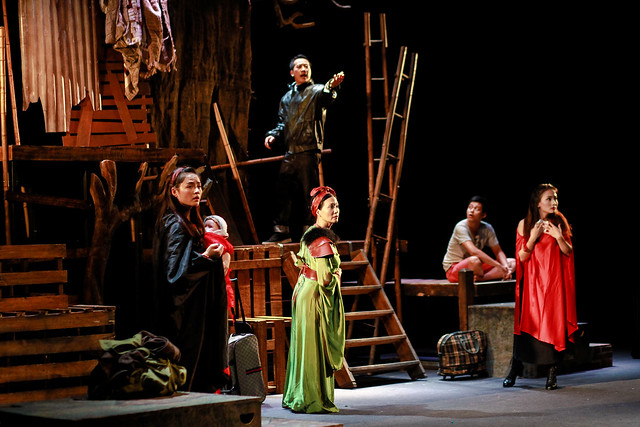
A German speaking director working with actors in a language he does not speak, delving into a theatre tradition quite foreign to his own, and relying on a Vietnamese translator to communicate with his Vietnamese cast. It shouldn’t work, but it does.
Just as the daring potpourri of a classic drama of German modernist theatre set after the Second World War, a Vietnamese actress being called by her role’s name, Grusche, props that reference modern Vietnamese life, costumes that feel a tad fancy dress, and an acting style that sways between accentuated drama and slapstick, somehow works.
The mix of culture, language, and the ages, reduces Brecht’s play to its essential timeless themes—greed, motherhood, and survival—which transcend centuries and borders.
& Of Other Things went to see one of the final rehearsals and got the chance to ask Dominik Günther about his most unusual collaboration.

Interview by Fabiola Büchele ● Photos by Huong
&: How do you direct a play in a language you don’t speak?
Dominik Günther: This is of course an immense challenge as communication between actors and their director is an essential part in putting a theatre play together. The translator [Le Quang] of the Chalk Circle had to create a Vietnamese version, which fit the Youth Theatre but was also understandable for a Vietnamese audience. And for me he had to create a script with which I could follow the German version parallel to the Vietnamese text so that I know what is being said.
During the rehearsals I had a translator who acted as my mouthpiece so that I could speak with the actors. Though by now I have invented a kind of fantasy body language. Over the last four weeks I have grown accustomed to the flow of the Vietnamese language and have developed the ability to sense the different emotions. This way I can assess whether an actor is emphasising and enunciating in accordance to my directing.

&: Some of your props are distinctly Vietnamese (i.e True Milk cartons, Ao Dais), did you choose those deliberately or because they are easy to come by?
Dominik Günther: The use of modern props was intentional to emphasis the current feel of the material. I think though that we will conceal some of the brands, because I want to tell a story that could take place anywhere in the world and not just specifically in Vietnam. These are the kind of details you suss out during the last week of rehearsal.

&: How is working with Vietnamese actors different from the Germans you usually work with?
Dominik Günther: I have been asked this a lot while working here and I have discovered that people who choose to work as an actor are all the same kind of mad. It’s a very unique profession for which you really have to be quite creative and be prepared to reveal a lot of yourself on stage.
Of course there are various forms of acting that are accentuated to different degrees in every country. In Germany for one, theatre is a lot more direct and more open. Vietnamese theatre draws more on a very expressive manner when it comes to gestures and emotions.
The actors at the Youth Theatre are incredibly open though and willing to take on an approach which to them is still a bit strange.

&: What have you learned here that you will take back to your work in German theatre?
Dominik Günther: In Germany the success of theatre is often made dependent on a controlled framework. In Vietnam there is a lot more improvising and the actors are very laid back about that. German theatre could do with a bit more nonchalance

&: How did you end up directing a Brecht play in Vietnam?
Dominik Günther: The idea to have a German director put on a Brecht play with Vietnamese actors was developed by the Youth Theatre in collaboration with the Goethe Institute. The director followed an invitation from the Goethe Institute to visit Berlin and watch a few German productions in Berlin and he left thrilled by German theatre.
The Goethe Institute then approached me to ask whether I would even consider such collaboration. I was immediately excited at the prospect of delving into a theatre culture that is foreign to me. As a director I am always in search of new cultural influences and experiences.
●●