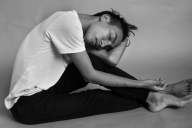
13 months spent together filming a documentary gives a lot to reminisce about for filmmaker Nguyễn Thị Thắm and transgender singer Phụng.
For her first feature-length documentary filmmaker Nguyễn Thị Thắm spent over a year with a travelling fairground troupe. Led by Madame Phụng on their journey through rural Vietnam, the group consists of 35 members, many of them transgender women.
Madame Phụng’s Last Journey is pared down to essentials – without embellishments or score – and despite showing an often desolate reality is littered with humorous and tender moments. & Of Other Things met up with filmmaker Thắm and lead singer Phụng, one of her main cast members, in a Hanoi hotel room to chat about the making of the film.
Although the troupe no longer exists the film’s current tour of the independent global film festival circuit means that they – along with their musings on love and heart wrenching songs, their lottery, rusty roundabouts and makeshift stage – now reach a much bigger audience.

Interview by Maia Do ● Edited by Rose Arnold ● Photos by Yên Nguyễn
&: How did you first find out about Bích Phụng’s group?
Nguyễn Thị Thắm: I have known about these kinds of troupes for a long time, since I was a little kid. During summer or Tet holiday, many groups like this set up their tents near where I lived when I was little. They fascinated me. When I grew up and started making films I thought I would love to make a film about one of these groups, I started looking for them. They used to be in Saigon, but now they have all moved to small provinces and the countryside. When I first began my search, I couldn’t find any. Then on a business trip to Nha Trang, I stumbled upon this group. The leader Bích Phụng told me that the group was actually looking for someone to film them and show people what LGBT life was like, what life in a group of troubadours was like. Great minds think alike! After that I took photos, do you remember? [turns to Phụng] I stayed for three days, taking photos and taking notes. Everyone accepted me naturally. Right from the moment I got there, we all felt close and talked easily.
Phụng: Yeah.
Nguyễn Thị Thắm: We met and immediately felt like friends. Chattering non-stop, filming, then going for some drinks and playing games.
Phụng: It was strange at first, but once we got to know each other, oh my lord, we were like close sisters.
Nguyễn Thị Thắm: At first, I slept in a hammock. Bích Phụng stayed with her husband. Later, the unmarried ladies let me sleep with them.
&: Just to clarify, there were two Phụngs in the group right?
Phụng: Yes, there are two Phụngs. Bích Phụng was the leader of the crew, and I am the singer.
Nguyễn Thị Thắm: The other Phụng [the leader] passed away seven months after we finished the movie in October 2010. Madame Phụng and one other lady, Hằng, she died one month after that. They were both diagnosed with HIV. Madame Phụng also had cancer. No one knew she was ill during filming. It was too late when we found out. She passed away soon after the diagnosis.

&: The group was a lottery-travel group, can you tell us more about those?
Nguyễn Thị Thắm: They sing and roll raffle. For example, they sing …
Phụng: … you have to sing to make rhymes with the numbers. [sings] Oh my country, how harsh life is! Poor but still happy like a bright moon in the black sky. My brothers and I, how hard we work! Poor but still happy with a passionate heart being free. This is number three.
Nguyễn Thị Thắm: So that’s the characteristic of these lottery-travelling groups. And when people hear the name ‘lottery groups’, they know immediately that transgender singers will perform because only transgender singers can sing the lottery beautifully. Right? I only hear transgender singers with voices like yours. Male and female voices are not as good, are they?
Phụng: There are straight male and female singers in the group, but their salary is not as high as transgender ones.
Nguyễn Thị Thắm: [The transgender singers] are one of the most attractive things about a lottery-travelling group.
Phụng: If a group arrives with a straight male or female singer, the audience will quickly get bored. There won’t be as big an audience as when us transgender singers perform.
&: Being so close to the group and spending so much time with them, how did you maintain your objectivity as a filmmaker?
Nguyễn Thị Thắm:I think it’s about experience. Before making this film, I participated in many documentary courses, and I made two short films even before that. And making those two films, I made that mistake of losing the distance. We call it the loss of distance, between the filmmaker and the characters.
This time, I had experience. At first when I went there and met everyone, there were so many people and I felt so tiny. I was afraid. I didn’t know what to do. They all looked like gangsters! [laughs] But after talking to everyone, I realised they were nice and adorable. And whenever I turned off the camera, we talked normally again. But once I picked up the camera, I was very aware that I was the filmmaker, and that I must not destroy the work by being too casual with them. I kept a distance between me, the filmmaker, and what I was filming. It’s not a tip or anything, but experience and my instinct.
I didn’t ask, or push, or tell anyone what to do. I just observed. The fact that I was close with everyone gave me an advantage, because when I observed them, I knew what they were like.

&: And how do you stay objective about the social issue you were portraying?
Nguyễn Thị Thắm: I am not here to raise a social issue, but simply to portray emotions. Actually, my only desire is to let people see what life is like for these ladies in the most authentic way possible. We cannot measure the objectivity and the authenticity. It depends on each audience when they watch the film. As for myself, I felt under pressure to get this right. For example, when I first met the group, I saw that life with them was so rich, so many characters moving around all the time, travelling constantly. I was stunned. I thought, “oh dear, how can I film all these? How can I portray their lives?” I was afraid that if I failed this film, and everyone watched it, they would be disappointed in me. I did have those feelings. But once that dramatic phase passed, I decided to be true to myself, to who I am. I would film whatever I had. Once I felt comfortable with myself as a filmmaker, the ladies also felt comfortable with my camera.
&: How did you plan filming?
Nguyễn Thị Thắm: During my three scouting days with them, I just observed them. I identified all the characters that I would film later. First was the leader [Bích Phụng], second Phụng here as the lead singer. Then there was a woman named Hang, who was like the representative of the old generations in the group. So, that’s how the story started to take on shape. I had a set of characters and the moving, the adventurous life of a group of troubadours. I thought of it in a very simple way. And what I liked when I met the group was the wandering.
As for the ending, when I imagined the film inside my head, I always thought that travelling groups like these would one day no longer exist. The longer I was filming, the more the feeling grew, that life like this cannot exist for much longer. Because, in the old time they could perform in the centre of big cities, but then they had to move farther and farther out. I thought because of the gradual development of society, of technology, other games and entertainments this would be pushed out. However, I made this film five years ago, and there are still so many, even more, groups now [turns to Phụng] Is that right?
Phụng: Oh, so many, everywhere. There are more and more. And now it’s even hard to find transgender singers like myself to sing!

&: How about the attitude towards transgender singers?
Phụng: Some people teased us.
Nguyễn Thị Thắm: They stared mostly.
Phụng: Yeah, like ‘so strange’.
Nguyễn Thị Thắm: But there are people who loved us. For example, when we were hungry, people brought us rice and fish.
Phụng: They were also very enthusiastic. They were like crazy fans giving us presents, money and flowers on stage.
Nguyễn Thị Thắm: Actually, it was a problem for me. People kept asking me why I was filming a transgender group. But in fact, all I came to do was film a normal fair, not the transgender aspect. In my eyes, they are all women, just like me, and I treat them like women. Also, when they were teased by the boys, I felt like the boys were teasing girls. So I lost that concept of gender. What I found attractive with this group is the adventurous life and I like that kind of life.
&: The film audience may be more aware of LGBT issues. How have they reacted so far?
Nguyễn Thị Thắm: When I first finished the movie it was shown in France, they reaction was really positive. I was so happy. There were some LGBT people in the audience, they came to me after the show and told me “we are gay, and when we watched your movie, we were so moved.” I felt like it had become something that touched people. Many people told me that when they watched the movie, they didn’t think of these people as different, that they were just normal people. These stories can happen to anyone, it’s not about gender difference. My movie does not look into gender difference.
●●
‘Madame Phung’s Last Journey’ won a Special Mention at the Indonesian Chopshot Festival and was screened at the European-Vietnamese Documentary Film Festival, Cinema Du Reel (France), Margaret Mead Film Festival (US) and the Human Rights Film Festival in Myanmar. It is being shown in Cambodia and Thailand before being released in New York this October and finally return for independent release in Saigon.