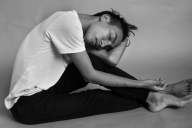
In Conversation: composer Dương Thụ and songwriter Đức Hùng talk about making music in Vietnam
Dương Thụ, 70 years old this year, is an accomplished and respected composer in Vietnam’s music scene, adored for contemporary works that are lyrical, mellow, and romantic. On the other hand, Đức Hùng, 24 years old, has only recently emerged on the scene after he participated in The Voice Vietnam 2013, and since then has turned to songwriting and producing. The younger is best known for the song ‘The Gardener and the Flowerpecker’, a sassy number stylistically inspired by musicals.
When the two spoke at Saturday Café – a cultural space in Ho Chi Minh City founded and organised by Dương Thụ every Saturday, where culture and art enthusiasts gather to have a dialogue on music, architecture, literature, art, cinema, etc. – it was music and their similar approach to it that bridged the contrast of age and time between them. What was intended to be a conversation, quickly transpired into a stimulating opportunity for the younger, less experienced generation to sit, listen and pose questions to the elder who provided comprehensive and candid answers about a life and soul of music.


Interview by Quyên Hoàng ● Photographs by Lee Starnes
ON CREATIVITY
Đức Hùng: We’re quite distant in terms of musical generations. How do you see the music of today? Of course we always need to update our music, but do you feel that music has been distorted nowadays?
Those who refuse to update won’t be able to be truly creative.
Dương Thụ: Nowadays the definition of music gets broadened more and more. I listen to music without any prejudice. For me, creative people always love trying out new things. People with presuppositions won’t be able to innovate. Those who refuse to update won’t be able to be truly creative. So I think there’s no conflict here. But I think new music is actually very easy to enjoy, it’s the avant-garde composers like Olivier Messiaen or Pierre Poulez that are more mind-blowing and intense.
ON THE PURPOSE OF WRITING MUSIC
Đức Hùng: I’ve read your book ‘Rain…Coffee’ and noticed at the back are prints of your music notations in the past. What was music to you when you wrote your very first works?
Dương Thụ: I didn’t dream to be a composer. My love for music came very naturally. I love it not because I have an agenda. I didn’t plan to study music to become a composer. I studied it because I like it. I studied art because I like to paint. I read a lot in the library for I love to read. No one forced me to do any of that. My time was different from yours which is very good nowadays, unlike the circumstances of my time. I had to do everything myself, learning on my own, rising above circumstances…To have a piano was unthinkable. To have classical music to listen to was extremely difficult. Honestly I did everything out of my natural passion. It had to come naturally. It resides in our soul, it grows, and becomes a part of your flesh and bone, not because you’re taught to love it. I compose because I like to compose. I didn’t write songs for singers, do you understand?
Đức Hùng: Yes, you mean you compose first and then you’ll work with singers who would like to perform that song?
Dương Thụ: I don’t write music for singers, I write for me. I was considered an underground guy, someone unorthodox. Everything I wrote came from who I am. I have an inability to do something outside myself. I need to have that love in order to do something. If it has an audience, it’s because there are people who feel the need for it. For example, when I collaborated with Hồng Nhung to produce the album ‘Garden of Stillness’…
Đức Hùng: ‘Garden of Stillness’ was wonderful, very chill…
Dương Thụ: …I told Hồng Nhung the album would no longer be a disparate group of songs, but a suite. Stylistically it was minimal, there are songs comprised of only three notes, with interval inversion. But that’s just in terms of form, the most important part is the soul. Her house was designed by me, and it has this little garden.
Đức Hùng: Yes, I’ve been there, it is beautiful.
Dương Thụ: I told her to spend time in that garden, where she could reflect herself in the sight of a dewdrop, a pebble, at the sound of rain, of the wind, of the birds singing…she needed to face them to ponder about her life. It’s a way to return to your own self.
ON THE PUBLIC’S TASTE
Dương Thụ: Frankly speaking, the job of a creative person is to generate the public interest, which is oftentimes very little at the very beginning. And if they tell us our music is hard to digest and thus dislike it, they’re right! How can they praise what they can’t appreciate? But don’t take their dislike as them being wrong. Once it’s beyond their usual perception, how can you force them to like it? Forcing them is a wrong approach to take. Do you understand?
Đức Hùng: So then how can we explain it to them?
Dương Thụ: Even if we want to we can’t, for people’s sense of taste depends on education. They need to learn. For example, if they desire listening to something more sophisticated, more skillful, and well-arranged, they need to get access to that kind of work first and form a listening and understanding habit in order to be able to appreciate works of the same kind. Culture is a process, it can’t be generated instantly.
You see people unable to appreciate good music, instead of criticising them you work harder so they can enjoy better music.
We’ve got to understand Vietnam is a poor country; our people mainly reside in the countryside, and our education curriculum is outdated. Therefore there are only a few outstanding individuals who can rise up against it to truly create something good, and the rest rightly reflects the social context. We need to get that down, so we don’t criticise the public’s taste unfairly. How could you point to a poor kid’s torn shirt and ask him why he’s wearing it? You see a poor kid wearing such a shirt, you must try harder so he doesn’t have to wear it anymore. You see people unable to appreciate good music, instead of criticising them you work harder so they can enjoy better music. If you tell them your taste is better and they should listen to it, it’ll come to a point where you’re coercing them, even if what you offer can do them some good.
ON ECONOMIC NEEDS
Đức Hùng: Do you think making a living poses as a heavy burden on making music? For example The Brotherhood Band all moved to the South and work with reality shows, music shows, etc., while singers are taking on the role of producers. How do you feel about that?
Those who feel dishonour while making money, they might get stronger in their creative process. So actually money only badly affects untalented people, but for truly talented ones, they can rise above those things.
Dương Thụ: It’s a matter of fact in life, everyone needs to make a living. Those guys get married, they have their wives and kids to tend to, they need to buy houses, vehicles, studios, etc. And no one gives you money for free, so you got to get to work. Making a living from music in other countries has the advantage of copyright protection. Once you made it and become famous, you’re paid extremely well. Yet it’s unfair in Vietnam. Creative people who have made a name for themselves get paid very little. That’s a harmful thing, very harmful, for their family needs to survive too. Needless to say it affects their career. [But] I think if you immerse yourself too much in making money, you’ll be selling out…
Đức Hùng: I agree, it’ll make a big difference.
Dương Thụ: But for those who feel dishonour while making money, they might get stronger in their creative process. So actually money only badly affects untalented people, but for truly talented ones, they can rise above those things.
ON THE INFLUENCE OF WHERE YOU LIVE
Đức Hùng: I live in the South, while you grew up in Hanoi. Where do you think we can have the serenity, the stillness needed to create good music?
Dương Thụ: Actually childhood is crucial, whether you grew up in Kiên Giang, Long An, Hà Đông or Hanoi. Whether you live by the river, sea, in the mountains, or the lowland region, it will nurture different qualities in you. Who you are is shaped by social and natural factors, together with the genes from your parents. All of which is concentrated in your childhood. It’s very decisive. There’s no such thing as this place is better than other places. I never emphasise such things in terms of creativity. No matter where people come from, what age they are, each of them has their own distinctiveness.
Đức Hùng: I think Northern culture is really cool. When I visited Hanoi, the culture, the life, and the people up there made me live a little slower compared to life in the South. I only spent ten days there but it inspired in me a kind of lifestyle that I think will nurture my emotions the best.
Dương Thụ: You’re a city person, aren’t you? You’re born in Saigon, right?
Đức Hùng: That’s right.
Dương Thụ: You open your eyes and there’s concrete blocks in front you…
Đức Hùng: Yeah, concrete, motorbikes, …
Dương Thụ: If you hold in mind the theory that being born and raised in the North would contribute to you creating resounding music then it’s not true. Firstly, during the French colonial time, it was the capital of Indochina, while Saigon was the capital of the South. The governor-generals, architectural structures were all in Hanoi. Fads that were created in Paris six months earlier would be brought to Hanoi. The elite was concentrated in Hanoi. The best people were in Hanoi because it was where the Indochina College was. The country’s best talents from other provinces all came to Hanoi. And if you studied in France, you came back to Hanoi to work. That’s why the culture in Hanoi was more profound, due to its solid intellectual foundation. All of the fields concerning culture were mostly in the North. You must understand that it’s the place that shaped the best of this country, thanks to the contribution of people from all over Vietnam, the essential beauty of Vietnam converged there.
ON MUSIC EXPERIMENTATION
Đức Hùng: Do you ever think of involving [yourself] in the modern music that we’re into?
Dương Thụ: I don’t think so. I think you shouldn’t call it ‘modern’…
Đức Hùng: No, my bad. It’s my choice of word. I mean ‘contemporary’.
Young people often consider themselves as being modern. But there are classical composers who are now breaking the rules, you might not be able to handle it.
Dương Thụ: The word ‘contemporary’ fits better with the culture that you grew up with. If you grew up listening to foreign music then it must have shaped your taste, but that doesn’t mean yours is better than others’. I mean the contemporary classical music is very awe-inspiring, unlike everyone’s conventional assumption about it. To the intellectuals, music isn’t merely entertainment. They want to live in it, with its structure, to nurture their souls, and that stems from the educated minds, not for entertainment. Young people often consider themselves as being modern. But there are classical composers who are now breaking the rules, you might not be able to handle it. In order to understand such music you must listen a lot. For example, I find your music interesting thanks to my knowledge of classical music and musicals, that’s how I can relate to your music. As for modernism, there’s no such thing. Contemporary is what’s happening now, which includes contemporary classic…
Đức Hùng: That’s right, I agree. Even classical music consists of contemporary classical music.
Dương Thụ: The most vigorous period for creativity is when you’re young. I personally like melody, rhythm, motif, etc. But in Vietnam there’s very little academic study, and it concerns a very small group of experts. Vietnam is dominated by ‘poetry singing’, because our language is phonologically rich. You only need to listen to a melody from a musician in order to determine how good he is. Music is all about arranging the sounds. Music creation in Vietnam is mostly amateur, which is ‘poetry singing’. Phạm Duy is a truly creative musical talent, a true composer whose contribution to Vietnamese music is monumental, even though he wasn’t classically trained. It’s because he has a good approach to music. When I talked to him, I told him his translating poems into music was very good, because he wasn’t restricted by the poems. Our ancestors were a phenomenon in that art. For example, the folksong ‘Con cò…
Đức Hùng: Bay lả ba la
Dương Thụ: ‘Bay từ cổng phủ bay ra cánh đồng’. If it’s merely poetry singing, the rhythm’s going to be ‘Con cò | Bay lả | Bay la | Bay từ | Cửa phủ | Bay ra | Cánh đồng’. But our ancestors broke out from that and turned it into music. Music needs melody. The melody itself doesn’t need lyrics, it can still express something, and associate itself with images. Therefore folk poetry was turned into a folksong. [singing] Con cò cò bay lả lả bay la. That’s real music. We can feel the smoothness in the melody. The song breaks out from the poem’s structure to stand by itself musically. That’s called songwriting, not ‘poetry singing’.
Music is not solely about lyrics. I don’t write music for anyone. My music is my soul, and that soul is expressed through sounds. Art is born from within, you can’t learn it from anywhere else
Đức Hùng: Yes, I understand now.
Dương Thụ: Music is not solely about lyrics. I don’t write music for anyone. My music is my soul, and that soul is expressed through sounds. Art is born from within, you can’t learn it from anywhere else.
Hồng Nhung and Mỹ Linh performing Dương Thụ’s ‘Trở về’
Ừ Thì – written and performed by Đức Hùng
●●
This interview was originally conducted in Vietnamese. It has been translated into English, edited and condensed.