
To gaze at a Lee Jin Ju painting is to enter a space of memories, vivid and detailed as the mind can be, fragmented and isolated as memories are.
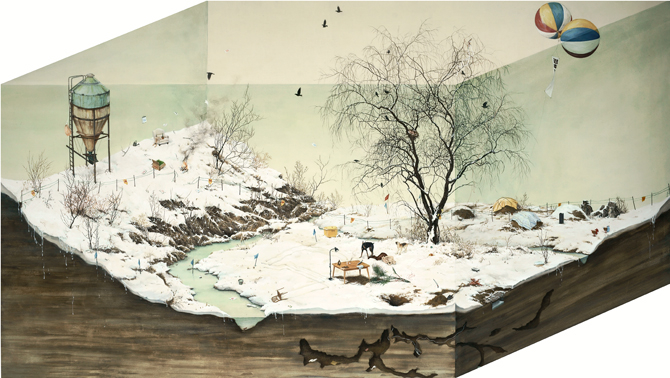
A Way to Remember by Lee Jin Ju – 140x250cm, Korean Colour on Fabric, 2010
Words by Sadie Christie ● Images Lee Jin Ju
Lee Jin Ju‘s landscapes, often barren winter terrains, are ripped from their earthly foundation and placed alone on the canvas as a floating island. Other scenes are literally boxed in to the canvas’ edges, making them inescapable and all encompassing. These are the psychological spaces where memories reside. For the artist it is a lonely place, filled with pain and loss scattered among the debris of memories we live again and again through psychological associations, signifiers we attach to the nouns of our experiences: hanging laundry, a plastic shovel, a paint roller, an old sneaker, a porcelain statue of the Virgin Mary.
Born in Busan, Lee Jin Ju graduated from Hongik University with a master’s degree in Oriental Painting. Her traditional education is apparent in the meticulously painted watercolour on fabric, a traditional Korean technique that depicts a variety of archetypal themes, including landscapes and portraits of beautiful women. Yet the distinct difference between this contemporary artist and traditional Korean art, lies in the way she applies such themes to her own work.
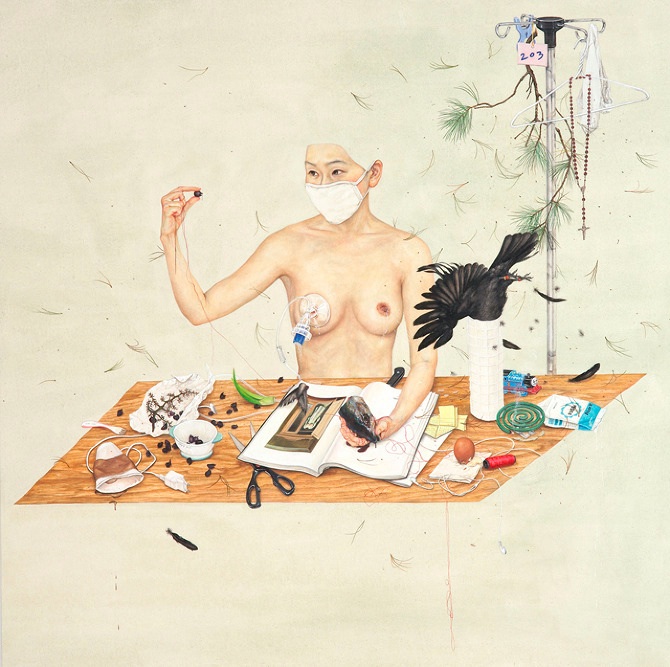
Restraints – Boundaries by Lee Jin Ju – 104x117cm, Korean Colour on Fabric, 2012
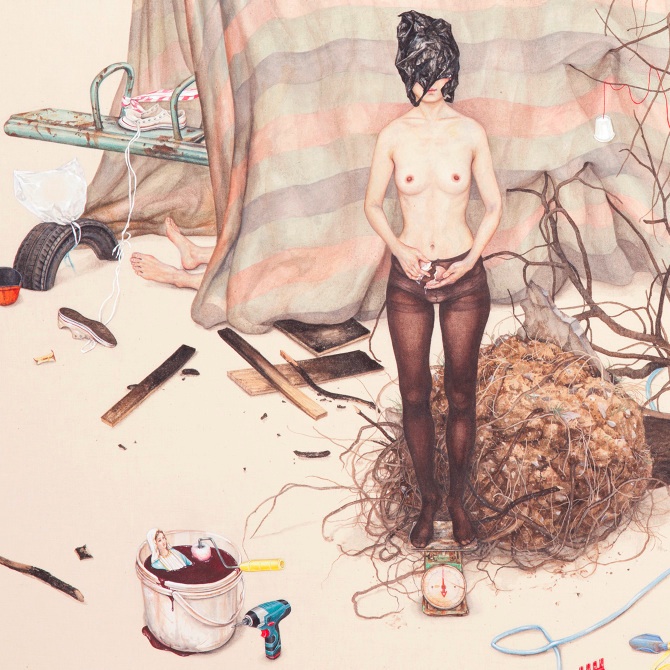
Fathom by Lee Jin Ju – 119.5×239.5cm, Korean Colour on Fabric, 2014
The portraits of beautiful Korean women have faces—withdrawn in sadness, contemplation, or responsibility— that are unaware of the spectator. They always appear half-nude, though there is nothing sexual about them. Instead their bodies tell the story of a distinctly female experience. They reference traditional gender roles, menstruation, pregnancy, babies, nylons and breast pumps.
In a synthesis of realism and surrealism, Lee Jin Ju’s paintings are somewhat reminiscent of Frieda Kahlo’s work, a graphic, perverse biography of her psychological reality and the painful experiences that shaped her life. Working through the symbols one at a time and all at once.
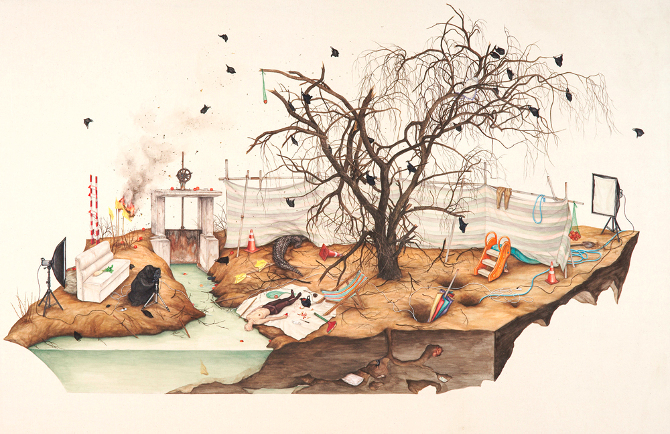
ManDIe by Lee Jin Ju – 130x163cm, Korean Colour on Fabric, 2012
When you step back to view Lee Jin Ju’s paintings as a whole (almost all of which measure a meter or more in height and length), a much larger story unfolds, somewhat like a memory map with no legend. As you allow your eyes to move across the space, more details become apparent, little things that lend themselves to memories of your own—things you didn’t see before, things you thought you had forgotten.
●●
Lee Jin Ju’s most recent exhibition was held at DOOSAN Gallery in New York, where she joined an exhibition of various Korean artists. You can view more of her work on her website: www.artistjinju.com


