Interview: YxineFF’s founder and former director Marcus Manh Cuong Vu on film as a tool for social change, dreamers and the significance of short-films in Vietnam
Five years ago, Marcus Manh Cuoang Vu, a Hanoian living in Europe, launched the online short film festival YxineFF. With the tagline Sharing.Love.Cinema, it has utilised the strength of its online existence and grown from a Vietnamese platform for sharing films, to a unique international film festival with an audience of 2.5 million viewers.
With friends strewn across the world, Marcus initially started the project in 2003 as a place for young film aficionados everywhere to share their passion online. He began noticing an increasing popularity of short film with their site – visitors who were producing and sharing their work as the technology to do so became easier to attain, but it lacked professional attention. Marcus decided it was time for a new direction, and the online film festival was held for the first time in 2010. Now, Marcus is retiring his post as director of YxineFF after ten years of promoting short film in both the Vietnam and international film scene. The festival will continue without him as he directs his attention to other cinematic and artistic endeavours. His final contribution to YxineFF will be finalising the official 2014 selection to be announced 19 September.
In light of his departure, & Of Other Things spoke with Marcus for a look back on what he has created, his view on young Vietnamese film makers and the hopes he has for the future of short film.
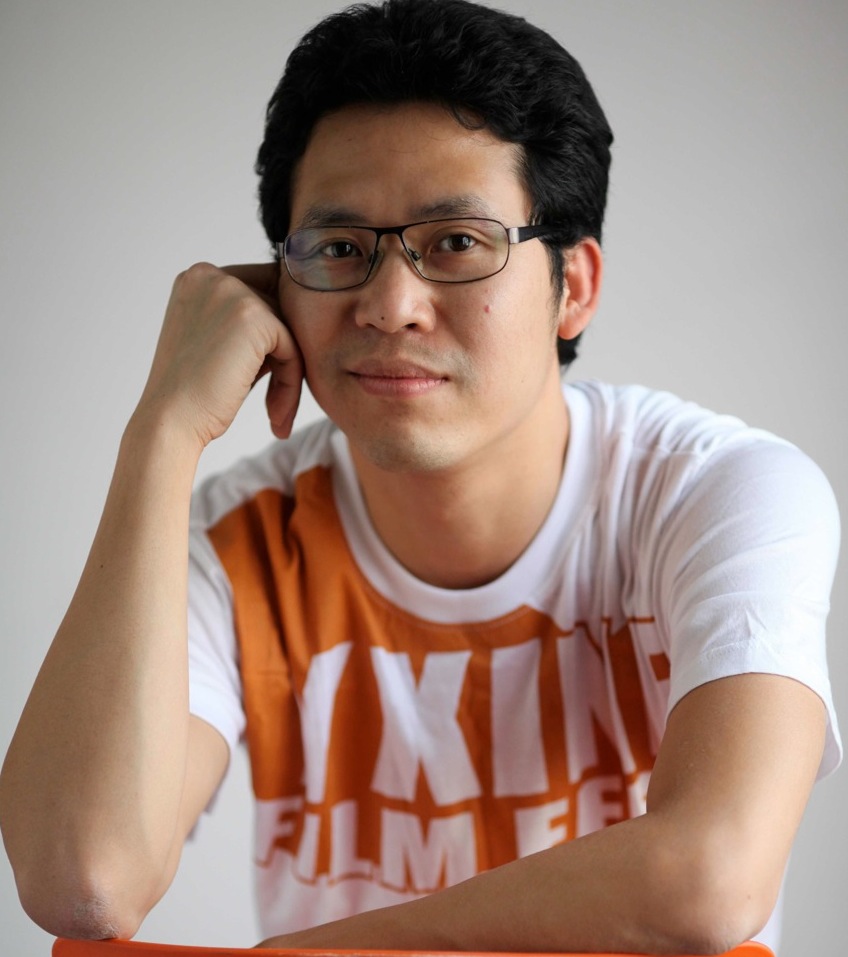
Interview by Nora Wehofsits ● Photo by Café Trầm
&: How do you see short film developing in Vietnam and what is happening in the young film scene as a whole?
Marcus Manh Cuong Vu: Both with the 5 year experience of doing YxineFF and from the perspective of a film critic I can tell you this: everything is developing pretty fast! It is incredible how Vietnamese short films tackle and carry themes relevant to society, despite censorship and the pressure to make a profit. This is a stark contrast to the commercial feature films which are being produced in Vietnam. Vietnam is an intriguing society on the ascend; there exists an unbelievable amount of topics for art, for film. The question is whether young filmmakers feel a calling to tackle and explore these themes. And I think young filmmakers are braving this.
Themes like generational and family conflicts or homosexuality being talked about is an important development. Or posing the question: what am I even doing in this society? How do I fit in? You can see young Vietnamese filmmakers delve into this in their short films, something that isn’t really the case in feature films. Those are mostly geared towards profit. The contradictions of Vietnam are being shown in the young, Vietnamese short films. It is what makes them so exciting and I hope that this trend will seep into feature films too.
&: Is that to mean that film is an especially important medium for the young generation to express itself?
Marcus Manh Cuong Vu: That’s right. Though it is of course also the task of established filmmakers to be asking questions. Looking for example at Iranian cinema you can see people like Panahi producing critical films despite all insecurity and adversities. That’s missing in Vietnam. There may be a lack of trust in social security and there is little belief that you are able to change something. Maybe there is also not enough conviction in personal values. You are part of society, part of the issue. This may explain the lack of critique but certainly does not justify it.
&: What is the cultural significance of film in your opinion?
Marcus Manh Cuong Vu: I believe film is important for the cultural development of a country. I believe that unlike other forms of art, film has the advantage that it can depict and explore themes on multiple layers. You have the visual aspect, the score, the lighting and the possibility to tell your story employing all of these. Film is the combination of different art forms and it merges the best of each for its own gain. On top of that film is a popular medium, especially in developing countries. In China cinemas are being built, in Europe they are closing down.
&: Don’t most of these new cinemas show commercial films rather than ones that are posing critical questions?
Marcus Manh Cuong Vu: That is precisely the problem. Take Vietnam as the example. There are hardly any independent distributors willing to promote critical or culturally challenging films. There are a lot of blockbuster cinema chains. Just as I believe that film can positively influence the development of a culture I do also think that the reverse can be the case. Films may have a negative effect on culture if they follow a single direction and are only being produced and distributed for profit rather than being challenging. And of course as history has taught us films can be employed as a manipulative propaganda tool.
&: YxineFF has a different topic every year. What is behind each of these themes?
Marcus Manh Cuong Vu: It all started with Love, derived from our motto Sharing.Love.Cinema. We think that all things have to start with love. In this case love for cinema, love for film. It is because of this love that we even started the whole thing. Without our passion we would never have been able to do this as project on a voluntary basis. It was purely out of love.
The themes that followed reflected the Zeitgeist and the essence of the films. Believing in yourself is essential to pulling off a film. Individuality is proving increasingly important in creativity, as the individual becomes the focal point. Being able to follow your passion coupled with the difficulty to make any decision. This ability to choose is incredibly important for today’s young generation, especially in Vietnam. They are faced with a choice: “Do we do what we really love and sacrifice all our time to it, or do we conform with what society deems normal, what is expected of us?”
For the selection of the films it is less about the [importance of] theme, but rather the overall quality of the film. If on top of that they fit the topic of the year, then perfect, but it is not a necessary criterion. For us the topic is essentially a message to the young filmmakers.
&: What about this year’s theme ‘Dreamers’?
Marcus Manh Cuong Vu: Surely you know Bertolucci’s, The Dreamers! I believe that people who have a passion for cinema are dreamers. And the people who make films also need to be dreamers, otherwise they wouldn’t be able to pull such a project together and see it through. You have to be a little bit mad and pack a lot of passion to be able to decide to make films and work as a filmmaker. This is where the connection to our earlier theme, Choice, can be seen. Films can be surreal, fantastical and still broach current issues. But yeah, films are dreams.
&: What does film mean to your personally?
Marcus Manh Cuong Vu: Film for me is passion. I grew up with film as a way to explore and make sense of the world. I was born in Hanoi after the war, a very isolated time during which not a lot of news was reaching us from the rest of the world. In the early 80s there was a wave of black and white films on TV and when I was a bit older you could also get films on the black market. Through these we had contact with the outside. Those films were a kind of education for me. Feature films and documentaries introduced me to a foreign world. I love nature and watched nature documentaries with a passion, whether they were about Africa, South America or Europe. You could see that worlds existed beyond your immediate surrounding. It was through film that I realised there was something else out there before I moved out of Hanoi for the first time when I was 17.
&: What are the perks for the makers of short films who submit their work to YxineFF?
Marcus Manh Cuong Vu: You reach a significantly bigger audience online. Our visitors are from all over the world; all they need is a working Internet connection. Watching the films on our website during the duration of the festival is free. To begin with the online format was an issue for some. They had their doubts thinking “oh, why would I want to show my films online”, but that changed. We are receiving more and more contributions, because filmmakers have realised the enormous potential of online distribution. We do also cooperate with distributors and ensure that the films are being seen offline.
●●
The official selections will be announced online on 19 September. All films will be made available online at www.yxineff.com. After touring through Vietnam in October the winning films will be awarded during a ceremony in Ho Chi Minh City in December. There are nine awards (Best Film, Directing, Screenplay, Cinematography, Editing, Performance, Best Production, Audience Choice, Press-Critic Jury.) in the four categories International Competition, Local Competition, Panorama, In Focus.
YxineFF is a voluntary, non-profit and independent project.