
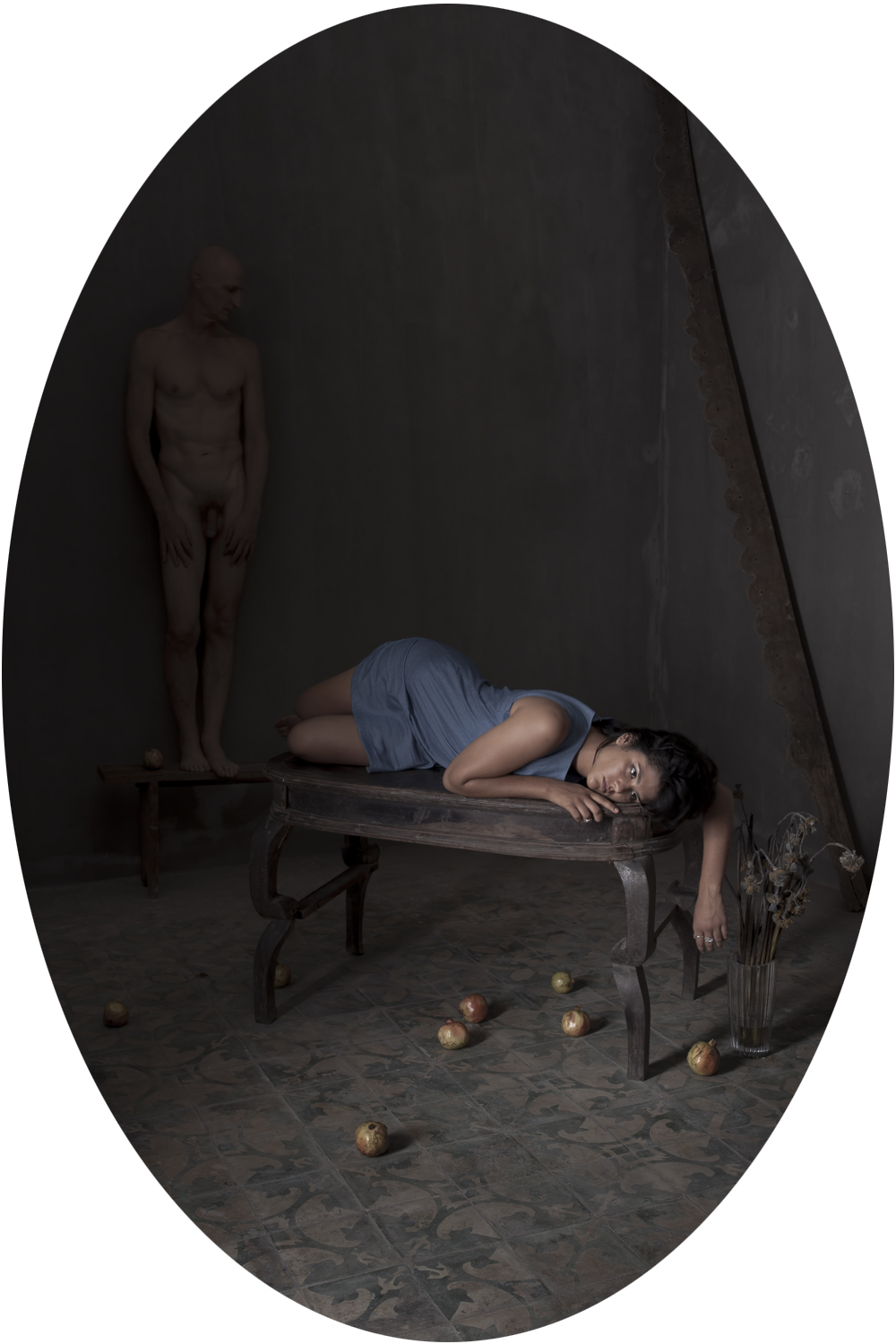
Adriana Dominique: What really intrigued me about the sitting was the set-up of the room, those muted colours, that stillness, that unearthly light. It was unlike any other place I had seen. I remember sitting, lying down, stretching, contorting; uncomfortable. I was very aware of myself, the shape my body was forming. I also remember concentrating to keep my body still and to keep any involuntary movements at bay. And tearing up as my open eyes grew excruciatingly dry.
Are there other ways you think you might approach reticence in the future?
You said your nudity in this series was a way of overcoming reticence in your work. Did it have the desired effect? Are there other ways you think you might approach reticence in the future?
Jamie Maxtone-Graham: I think the idea of pushing oneself creatively can take on many, many forms; the decision to appear nude in the work was only partly about addressing something personally. The nudity could not exist in any project simply for its own sake but it was right for this work. The more important idea for me is simply appearing in the work; breaking the fourth wall. The nudity is secondary – though also essential. So, on the one hand while the nudity of the photographer in the image is an important element, I think conceptually the presence of the photographer in the work is the more important discussion. I guess this would lead to the question ‘then why be nude’?
Initially, the idea was that I would be the only person nude in the whole series but this evolved as I began making the work and so people I posed with also began to appear partially or entirely nude. You and I met the very day we made this image together and I suppose if I had felt braver, I might have asked you if you would consent to also appear nude. But I’m not sure if we could have made this image better because of it. There is something so exquisite about the way you lay yourself across that table – a pose you found by yourself – that I’m not sure if your nudity would have improved on the image. It may not have detracted, but I cannot assert it would make it better.
In the creation of this series I was partially interested in some kind of conversation with art, with art history, so I enter the work in the guise of the classical male nude. It’s a role. And so I came to realize, a performance. The poses in each image, while somewhat considered ahead of making the actual image, are also quite spontaneous and often are a reflection of the other person in the photograph, a mirroring. This was an unexpected development in the work. It wasn’t used continually, but I tried it when it seemed like an appropriate approach in a given situation with a particular person.
I know I require a greater sense of courage in myself. I often find myself not asking questions I later wish I had, of not pushing myself hard enough, of being too polite.
I can’t predict how to deal with reticence in future work but I know I require a greater sense of courage in myself. I often find myself not asking questions I later wish I had, of not pushing myself hard enough, of being too polite. This is not an easy element to overcome. But I actually find that creatively, with a camera, I can get to know things about people, about myself – and share very personal things with others – that in any other situation would simply not exist or might be considered inappropriate. For example, I invited an acquaintance to pose with me for this series and I explained that I would also be in the photograph without any clothes on and she kindly explained to me that this was the last thing she would be interested in doing. I can understand that. The camera cannot justify every behavior.


